
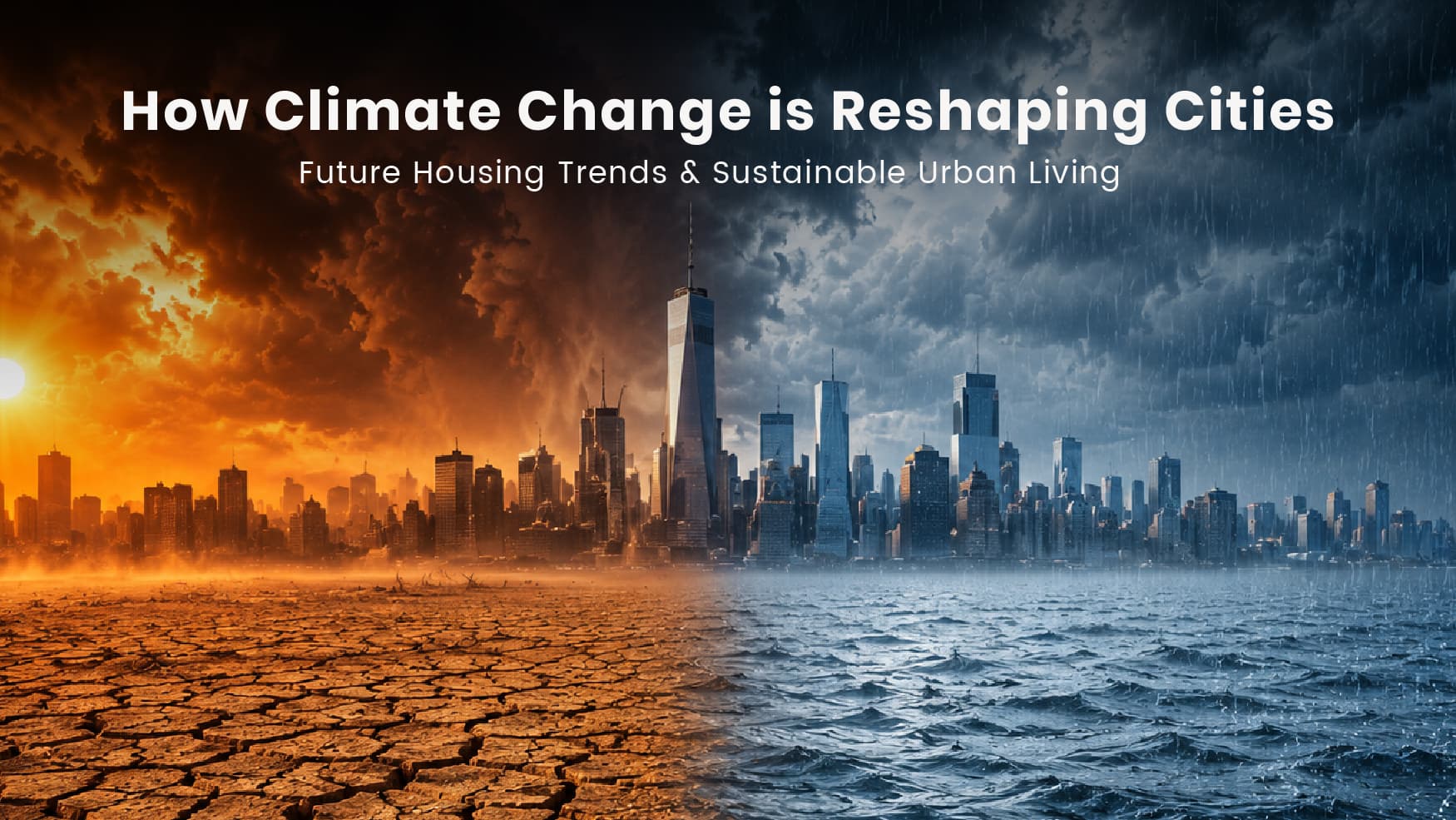
There was a time when buying a home in India felt uncomplicated, guided by familiar priorities like neighbourhood reputation, school catchments and commute times. That simplicity is fading because across Indian cities, climate change is slowly but unmistakably threading its way into everyday housing decisions, changing what buyers prioritise and what investors consider risk. Seasonally waterlogged streets, summers that push human tolerance and civic systems buckling under decades of unplanned growth alter the ground beneath the property market quite literally.
Climate change in real estate is no longer a niche conversation reserved for environmentalists but a mainstream investment lens that homebuyers, developers, and urban planners across India are being compelled to adopt.
How Climate Change Is Affecting Real Estate
Anyone who has watched a basement flat flood three times a day during the monsoon, or seen an electricity bill double over a single summer, understands instinctively what the data is beginning to prove. According to 99acres, flood-prone properties tend to be appreciated more slowly than better-drained areas.
- Rising urban temperatures in cities like Ahmedabad, Nagpur, and Delhi regularly exceed 45°C, driving up cooling costs and placing electrical networks under considerable seasonal strain.
- Flood-risk properties in India continue to push heavily on low-lying areas across Mumbai, Chennai and Kolkata, where recurring monsoon damage steadily erodes ownership returns.
- Deteriorating air quality is pushing buyers towards peripheral localities that promise cleaner, less congested living.
- Rising insurance premiums across climate-vulnerable zones are adding financial layers that serious investors can no longer afford to overlook.
Impact of Climate Change on Property Demand
Buyers across India are making decisions today that their parents never had to consider, quietly factoring in tree cover, drainage quality, and breeze corridors alongside bedroom counts and carpet area. According to Housing.com, searches for greener, low-density neighbourhoods have amplified, signalling a significant transformation in the understanding of an ideal home.
- Sustainable urban development is gaining traction as integrated townships with landscaped buffers and water management systems draw noticeably stronger buyer interest.
- Heat-resistant housing features like cross-ventilation and reflective roofing are increasingly becoming standard among discerning buyers.
- Demand for smart cities in real estate is rising as homebuyers are aware and looking forward to future-ready communities that promise reliable infrastructure and reduced long-term living costs.
- Climate resilience is becoming a luxury differentiation, with premium developments leading sustainability adoption, while affordable housing segments struggle to keep pace.
Flood & Heat Risk Zones in Indian Cities
Buying property in an Indian metro today without assessing climate risk is a bit like choosing a neighbourhood without checking the commute; it catches up with you eventually, and usually at considerable cost.
- Flood risk property in India is most visible in Mumbai, where affected areas, including some premium projects that do not possess green certifications, face weaker appreciation potential over time.
- The heat island effect across Delhi, Pune, and Hyderabad sees densely built neighbourhoods recording temperatures far higher than greener, more breathable surroundings.
- Coastal cities like Chennai and Kochi face compounding sea level risks, making elevation and drainage quality parameters that no informed buyer can afford to skip.
- Water scarcity is quietly but persistently disrupting liveability across several Bengaluru and Pune micro-markets.
Rise of Smart & Resilient Housing
The most encouraging shift in India's real estate landscape is that sustainability is no longer being bolted on as an afterthought but is being designed in from the foundation upwards, quite literally.
- Green building certifications like IGBC and GRIHA are gaining real popularity, with certified projects benefiting from measurably stronger buyer trust and appreciated resale values.
- Solar energy and water recycling are quietly crossing over from aspirational features to everyday necessities in future-ready properties across tier-one cities.
- Smart cooling systems with ventilation and thermally responsive design make urban living genuinely more bearable as temperatures climb.
- Sustainable materials like fly ash bricks are trimming both environmental impact and the maintenance bills that catch owners off guard years down the line.
- Tech-enabled smart homes are finding a receptive, growing audience among buyers who want their home to work as intelligently as they do.
Future City Planning & Urban Development
India's cities are slowly but unmistakably beginning to plan for the climate they are inheriting rather than the one they grew up in, and that shift is starting to show up in policy, infrastructure, and master plans.
- As sustainable cities in India take shape under the Smart Cities Mission, investors are beginning to recognise that climate-conscious urban planning directly strengthens long-term property values.
- Transit-oriented development is pulling housing and commerce closer to efficient transport corridors, quietly reducing the sprawl that makes cities harder to cool and connect.
- Urban forests are finding their way into master plans as planners recognise that trees do infrastructure work that concrete simply cannot.
- Government regulations around energy efficiency and green building compliance are tightening, nudging developers towards construction practices that future generations will actually thank them for.
Why Investors Are Looking at Future-Ready Properties
The smartest investors in Indian real estate are no longer just asking what a property is worth today but what it will cost to own, maintain, and exit five or ten years from now, and climate risk is sitting squarely at the centre of that calculation.
- Investors are directing capital towards sustainable cities in India, recognising that climate-conscious planning quietly but consistently delivers stronger long-term asset value.
- Future housing trends are favouring communities with green cover and passive cooling, where lower operational costs make ownership genuinely more financially sustainable over time.
- Demand for climate-resilient housing is already translating into stronger rental returns and resale appreciation across tier-one cities, rewarding early movers considerably.
- ESG mandates are accelerating capital flows towards climate-smart real estate, making sustainability credentials a baseline requirement rather than a bonus for institutional investors.
Conclusion
The Indian cities built over the next 10 years will either age gracefully or buckle under the pressures of climate change, which already exist and are intensifying. For homebuyers and investors who are paying close attention, climate change in real estate is not a warning but a compass, pointing towards sustainably built, well-planned, smart cities as the precisely convenient options for a prosperous future.
Invest in future-ready properties.